

It often starts quietly.
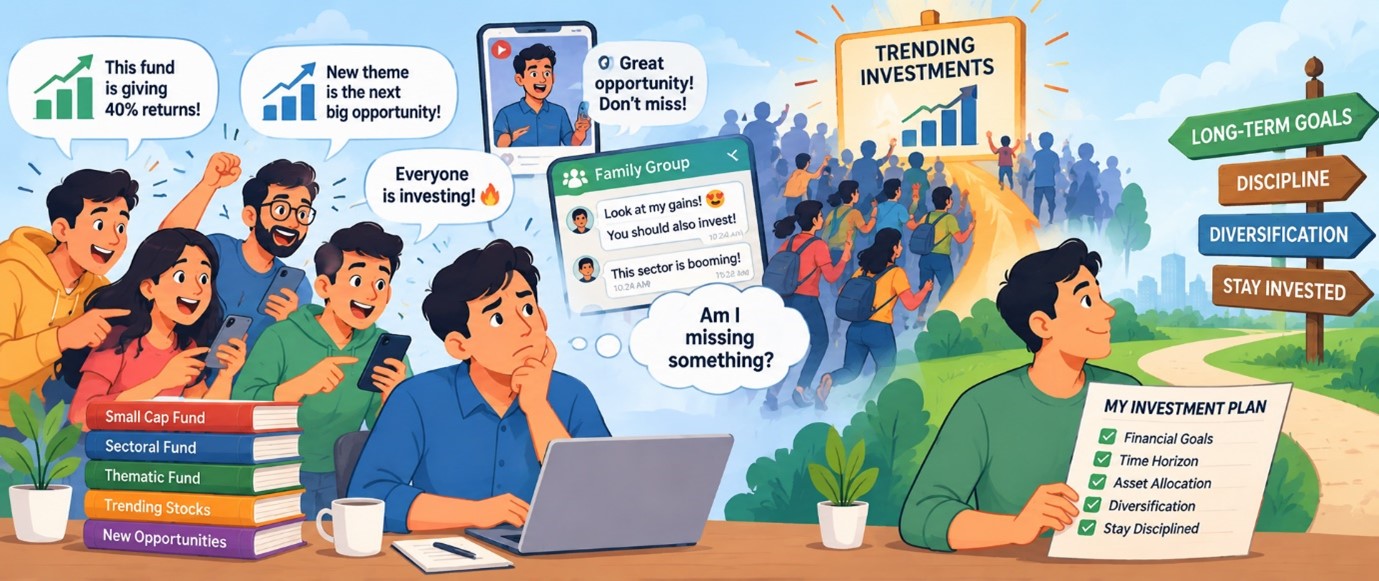
A colleague mentions a fund that has delivered impressive returns. A family WhatsApp group fills with screenshots of someone’s investment gains. A financial influencer you follow starts talking enthusiastically about a new investment theme.
Suddenly, your own portfolio—a simple, diversified index fund that has been steadily following its strategy—starts to feel inadequate.
Maybe even boring.
You begin to wonder whether everyone else has discovered something that you are missing.
This is herd behaviour, and it is one of the strongest psychological influences on investor decisions.
It does not happen because investors are foolish. Following the group is a deeply rooted human instinct. Throughout history, staying with the group often provided safety, while moving in the opposite direction could carry real risks.
In financial markets, however, that instinct can sometimes work against investors.
The crowd often becomes most interested in an investment after it has already delivered strong recent performance. By the time a particular fund, sector, or theme dominates conversations, some of the earlier gains may already have occurred.
What Does Herd Behavior Look Like?
Herd behavior rarely begins with one dramatic decision.
Instead, it develops through a series of small, seemingly reasonable steps.
You start reading about the investment everyone is discussing.
You look at its recent returns.
You tell yourself that you are simply doing research.
Then you decide to invest a small amount “just to see how it performs.”
Eventually, your original diversified portfolio begins to look less attractive by comparison.
The potential cost is not necessarily a large loss in the new investment.
Sometimes the bigger cost is losing the clarity of the original investment plan.
The portfolio becomes more complicated. Investments overlap. Different themes are added without a clear purpose. And the simple strategy that was originally designed around your goals can gradually become difficult to maintain.
Social Pressure Is Real
There is something important worth acknowledging.
Sticking with a quiet, disciplined investment strategy while people around you are discussing exciting opportunities can be genuinely difficult.
When someone tells you about a 40% return, it is natural to wonder why your own investment did not deliver something similar.
But remember that you are usually seeing only one part of the story.
Someone may share their successful investment in a group chat without mentioning the investments that performed poorly.
A fund that delivered 40% in one year may have experienced very different results during the years before or after that period.
The excitement may be real.
But the information being shared is often incomplete.
Why Passive Investing Can Help
A passive investment strategy is generally built around factors such as financial goals, investment horizon, asset allocation, and a defined index methodology.
Those factors do not automatically change because someone in a group chat had an exceptional year.
The key question becomes:
“Does this new investment serve my goals better than what I already own?”
If the answer is no, there may be little reason to change the plan simply because the investment has become popular.
Passive strategies can also reduce the pressure to constantly identify the next winning sector or investment category.
You do not have to predict which part of the market will perform best next.
And when you are not trying to identify the next winner, you may also feel less pressure when other investors appear to be finding one.
What Can You Do Instead?
Create your investment plan before the noise begins.
Write down:
- Your financial goals
- Your investment time horizon
- Your target asset allocation
- The role of each investment in your portfolio
- The circumstances that would make you review or change the plan
A written plan can provide a useful reference when emotions and social pressure begin influencing your decisions.
When everyone around you starts talking about a particular investment, instead of immediately asking:
“Should I follow them?”
ask:
“Does this fit the plan I already created?”
That small change can help turn an emotional decision into a structured one.
Your Plan Does Not Have to Follow the Crowd
Markets will always move from one popular theme to another.
There will always be a fund that has recently performed exceptionally well, a sector attracting attention, or an investment story that everyone seems to be discussing.
You do not have to participate in every trend.
The crowd will always be moving toward something. Your investment plan does not have to move with it.
Leave a Reply