
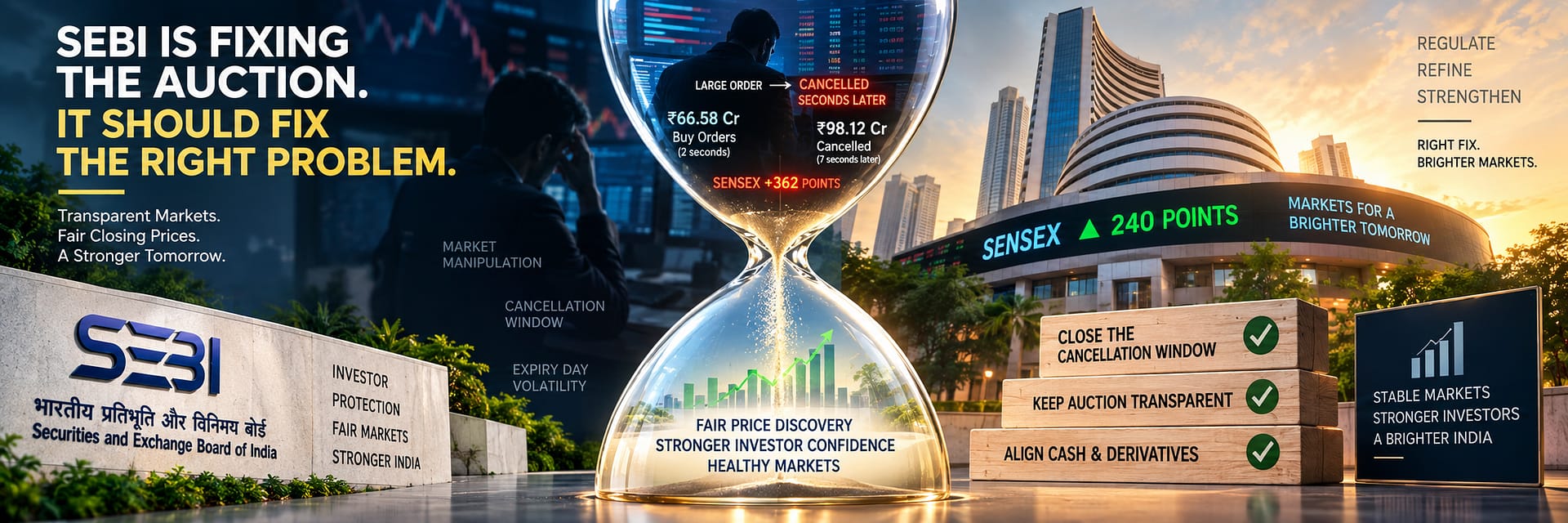
SEBI is preparing to change the way futures and options settle on expiry day. But before fixing the mechanism, it is worth asking a more fundamental question:
Was the auction actually the problem?
Just a month after India’s market introduced an auction-based closing mechanism, the focus has shifted toward changing how futures and options are settled on expiry day.
But the auction itself may not deserve the blame.
The real trouble appears to have come from the cancellation window—the part of the process that allowed orders to be withdrawn and potentially created distortions around the market close.
That distinction matters.
An auction is designed to bring buyers and sellers together and establish an orderly closing price. It can improve price discovery by concentrating trading activity at a specific point rather than allowing the final traded price to be determined by a handful of transactions.
If the mechanism is functioning as intended, the question should not be, “Why do we have an auction?”
The better question is:
“Which part of the auction process created the problem?”
Changing the settlement framework may address the symptoms, but it risks overlooking the underlying issue.
Markets need rules that promote fair price discovery, reduce opportunities for manipulation, and provide certainty to participants. That requires regulators to distinguish between a mechanism that is fundamentally sound and a feature within that mechanism that may need adjustment.
The auction shouldn’t be judged by the problems created around it.
SEBI should fix the part that needs fixing—not the part that happens to be easiest to change.
The objective should be simple: a more transparent, predictable and efficient expiry-day process without unnecessarily disrupting a mechanism that can contribute to better price discovery.
On August 13, something unusual happened in the Sensex closing auction.
According to SEBI’s interim order dated August 19, two entities allegedly moved the Sensex closing level by around 240 points by placing large orders in the cash market. The strategy reportedly involved ₹57 lakh in the cash market and generated around ₹3.68 crore through options.
But there is an important detail that deserves attention:
The auction did not fail. It worked.
The transparency of the auction mechanism helped identify the unusual activity within six days.
The real weakness appears to be somewhere else—a short window during which large limit orders can be placed and then cancelled just seconds later.
That is the part that needs fixing.
Instead, SEBI has indicated that it may change the way derivatives are settled on expiry day. That could create an unintended consequence: one market potentially ending with two different closing prices.
For long-term investors, there is no immediate action required. But the proposed reform deserves careful scrutiny because the way an index closes matters to everyone who uses it.
Why the Closing Auction Matters
A month ago, we argued that the introduction of the closing auction was a positive change.
The reason was straightforward: an index fund should ideally be able to transact at the same price on which its benchmark index is calculated.
A transparent closing auction helps achieve exactly that by bringing orders together and establishing a closing price through a defined process.
We did, however, flag one potential weakness.
The first day of the new mechanism was somewhat untidy, but it was not an expiry day.
Expiry day is different.
That is when large amounts of money can move based on the final value of the index.
It took only ten days for that risk to become visible.
What Happened on August 13?
August 13 was the weekly Sensex expiry.
According to SEBI’s interim order, during the first two seconds of the closing auction, a foreign portfolio investor placed ₹66.58 crore worth of buy orders across all 30 Sensex stocks.
Those orders represented 99.91% of the total buy interest during those opening seconds, with every order placed at the 3% upper price limit.
The Sensex subsequently jumped by 362 points.
Then, at 3:26 pm, the entity cancelled ₹98.12 crore of orders that it had placed just seven seconds earlier.
The entity also held call options and had written put options around the 78,000 strike levels. A higher closing index value would benefit both positions.
SEBI’s order alleges that two entities were involved in the activity.
The important point, however, is not simply what happened on that particular day.
It is why the market structure allowed such activity to happen in the first place.
The Design Gap Is Surprisingly Narrow
The problem appears to lie in the timing of order cancellations.
Market orders are frozen at 3:25 pm. However, limit orders can still be placed and cancelled until the random closing time.
That creates a small but potentially powerful window.
Both entities allegedly used that window.
Other major markets have taken a different approach.
The New York Stock Exchange, for example, freezes cancellations before the close, while Hong Kong also restricts cancellations during the final stage of its closing process.
India could consider a similar solution.
Simply extending the cancellation freeze to limit orders could potentially eliminate the opportunity that existed on August 13.
In other words, the solution may require changing one small part of the auction process, rather than changing the settlement mechanism itself.
What SEBI Has Proposed Instead
On September 3, SEBI said it had gathered feedback from a wide range of market participants, including brokers, proprietary traders, foreign investors, mutual funds and even social media discussions.
One concern is particularly important for investors.
If stocks are valued using the auction closing price while the corresponding futures contract settles using an average price, the two markets would no longer converge at the same level.
That creates a structural mismatch.
Every expiry could then carry a difference between the cash-market close and the derivatives settlement price.
What might initially appear to be a small adjustment could therefore create a permanent source of tracking noise.
And that matters for products investors typically expect to be simple and predictable.
The Index Fund Problem
Many index funds and ETFs use index futures as part of their portfolio management process.
For example, when fresh money enters an index fund, the fund may temporarily use Nifty futures before purchasing the underlying stocks. The futures position and the underlying holdings can then be aligned around the market close.
This works smoothly when the futures settlement price and the index closing value are closely aligned.
Separate the two, and the process becomes more complicated.
The result could be additional tracking error and NAV noise—precisely in investment products that investors choose because they are designed to closely follow an index.
That is why the distinction between fixing the auction and changing the settlement price matters.
Fix the Weakness, Not the Mechanism
The August 13 episode highlights a genuine weakness in the current process.
But the evidence also suggests that the closing auction itself did what it was designed to do: it created a transparent mechanism through which unusual activity could be identified.
The question, therefore, should be:
Do we need to change the auction—or do we simply need to close the cancellation window that allowed the problem to occur?
If the problem is the ability to place a large order and cancel it seconds later, then that is the part that should be addressed.
Changing the derivative settlement price could solve one problem while creating another—potentially leaving the cash market and derivatives market with different closing prices.
That would be an unnecessarily complicated outcome.
For long-term investors, there is nothing they need to do today.
But this reform is worth paying attention to.
India’s market needs a closing mechanism that is transparent, fair and difficult to manipulate. The auction can be part of that solution. The goal should be to strengthen it—not weaken the connection between the index and the instruments designed to track it.
by VM Capital Groww
Leave a Reply