How to Build a Financial Corpus for Your Child’s Future
Every parent dreams of giving their child the best possible education. Whether it is pursuing engineering, medicine, management, professional studies, or higher education abroad, the cost of education can become a significant financial responsibility.
The challenge is not only the cost of education today. Education expenses are likely to increase over the years, which means parents need to plan for a future amount rather than simply considering today’s fees.
This is where child education planning becomes important.
Instead of waiting until the child is ready for college, parents can start investing early and gradually build a dedicated corpus for the education goal. Starting early can give investments more time to grow and can make the required monthly investment more manageable.
In this article, we will understand how child education planning works, how much you may need, different investment options available in India, the role of SIPs, the importance of insurance, and some common mistakes parents should avoid.
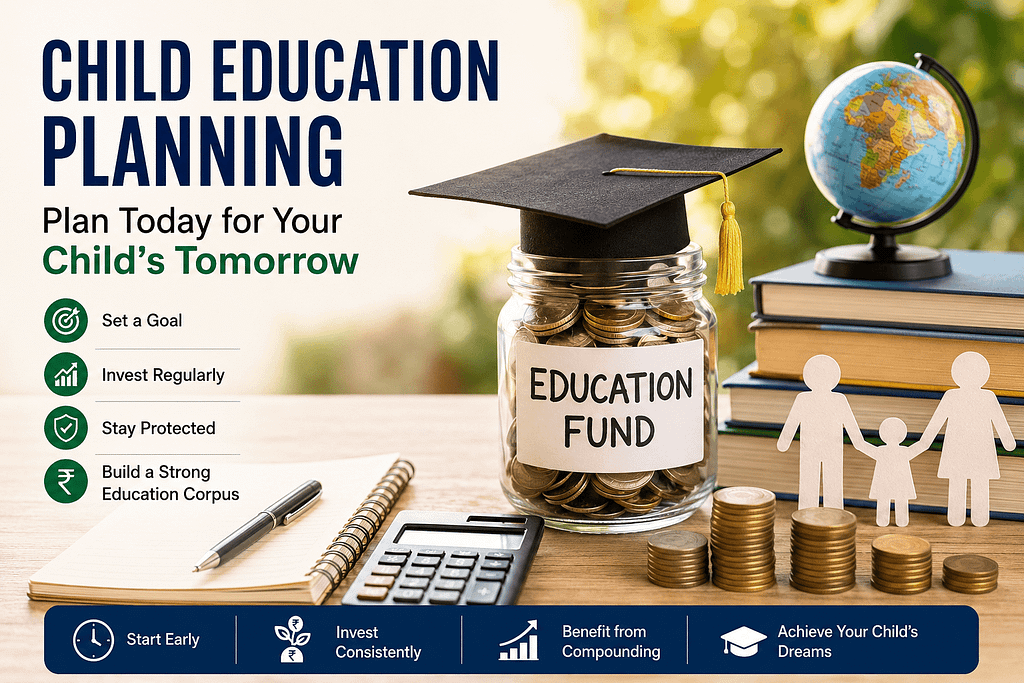
What Is Child Education Planning?
Child education planning is the process of estimating the amount required for your child’s future education and creating an investment strategy to accumulate that amount before the goal arrives.
It involves more than simply saving money every month.
A proper education plan should consider:
- Your child’s current age
- Expected age for higher education
- Current education costs
- Future inflation
- Type of education your child may pursue
- Whether education could be in India or abroad
- Your current savings and investments
- Your monthly investment capacity
- Your risk tolerance
- The amount of financial protection required for the family
The objective is simple:
Build the required education corpus before your child needs it.
Why Should Parents Start Planning Early?
One of the biggest advantages parents have is time.
Suppose your child is currently five years old and you expect higher education to begin around age 18. You have approximately 13 years to build the required corpus.
If you start when your child is 15, the investment period may be only three years.
The shorter the investment period, the greater the amount you may need to invest to reach the same target.
Early investing can also allow you to benefit from the power of compounding, where returns generated by an investment can themselves contribute to future growth.
However, market-linked investments do not guarantee returns. The actual outcome will depend on the investment selected and market performance.
How Much Will Your Child’s Education Cost?
This is one of the most important questions parents should ask.
Looking only at today’s education fees can lead to underestimating the amount required in the future.
For example, suppose a course currently costs ₹10 lakh. If education costs increase over time, the amount required when your child actually enters college could be significantly higher.
Therefore, parents should account for education inflation when setting their target.
Factors to consider when estimating the future cost
Your calculation may include:
- Tuition fees
- Hostel or accommodation expenses
- Books and study materials
- Transportation
- Living expenses
- Professional training
- Entrance examination costs
- Overseas education expenses, if applicable
- Other education-related costs
The objective is not to predict the exact course your child will choose.
Instead, create a realistic target based on the type and level of education you want to financially prepare for.
A Simple Example of Education Planning
Consider a child who is currently 8 years old.
The parents expect the child to pursue higher education at around 18.
That gives them approximately 10 years to build the required corpus.
Suppose they estimate that the education goal could require ₹25 lakh in today’s terms.
The future requirement will need to be higher after considering inflation.
This illustrates an important principle:
The education goal should be calculated in future-value terms, not simply based on today’s cost.
Once the target amount and investment period are known, parents can determine an appropriate investment strategy.
Investment Options for Child Education
There is no single investment product that is suitable for every child education goal.
Parents can consider different financial products depending on the investment horizon, risk profile, liquidity requirements, and objective.
Some commonly considered options include:
1. Mutual Funds
Mutual funds can be considered for long-term financial goals such as children’s higher education.
Depending on the investment objective and risk profile, investors may consider equity-oriented, debt-oriented, or hybrid mutual fund categories.
Equity-oriented investments can offer higher long-term growth potential but can also experience significant market fluctuations.
Debt-oriented investments generally have different risk and return characteristics.
Therefore, the investment selection should be based on the time available for the goal and the investor’s ability to tolerate market fluctuations, rather than simply choosing a fund because of its recent returns.
2. Systematic Investment Plan (SIP)
SIP is a method of investing a fixed amount periodically in a mutual fund scheme.
Instead of waiting to accumulate a large lump sum, parents can invest regularly—for example, every month.
AMFI describes SIP as a periodic investment method that can help investors maintain discipline and benefit from rupee-cost averaging.
For a long-term child education goal, SIP can therefore be a convenient way to invest consistently.
However, SIP itself is not an investment product or a guarantee of returns. The underlying mutual fund determines the investment risk and potential return.
3. Sukanya Samriddhi Yojana
For eligible girl children, Sukanya Samriddhi Yojana (SSY) is a government-backed small savings scheme intended to encourage long-term savings for a girl’s education and future needs.
The account can generally be opened for a girl child up to the prescribed age limit, subject to the scheme rules.
For the July–September 2026 quarter, the notified interest rate is 8.2% per annum, with rates subject to government review and notification.
SSY can therefore be one component of an overall education plan, but parents should evaluate it alongside their overall financial goal, investment horizon, and liquidity requirements.
4. Traditional Savings and Fixed-Income Options
Parents may also use options such as fixed deposits and other fixed-income instruments for portions of their education corpus.
These can provide greater predictability than market-linked investments, but their growth potential and taxation can differ from other investment options.
The suitability of these products depends on the time remaining before the education goal and the parent’s overall asset allocation.
5. Child Insurance Plans
Some insurance products are specifically designed around children’s future financial needs.
These plans may combine insurance protection with savings or investment components.
However, parents should carefully examine:
- Life cover
- Premium commitment
- Charges
- Lock-in conditions
- Surrender terms
- Investment flexibility
- Expected benefits
- Actual insurance requirement
Insurance and investment are different financial objectives. Combining both in one product may not always be the most efficient approach for every family.
Should You Invest in a Child Education Plan?
A product marketed specifically as a “Child Education Plan” is not automatically the best solution for every family.
The more important question is:
Does the investment strategy have a reasonable chance of helping you achieve your education goal within the available time?
Parents should compare the product based on:
- Expected goal amount
- Investment period
- Risk
- Costs and charges
- Liquidity
- Investment flexibility
- Insurance protection
- Tax implications
- Exit conditions
Instead of selecting an investment only because it carries the word “child” in its name, focus on whether the product fits your overall financial plan.
Insurance and Child Education Planning
There is another important aspect that parents should not overlook: financial protection.
Imagine a parent is regularly investing towards a child’s education but unfortunately passes away before the goal is reached.
The family may then struggle to continue the education investment plan.
This is why education planning should be considered alongside adequate life insurance protection for the earning parent or parents.
A suitable term insurance policy can help provide financial protection to the family in the event of the policyholder’s death.
The amount of life insurance required should be based on the family’s overall financial responsibilities, liabilities, income replacement needs, and future goals—not merely on the cost of the child’s education.
Should the Investment Be in the Child’s Name?
Parents sometimes assume that investing in the child’s name is automatically better.
That is not necessarily the case.
Mutual fund investments can be made in the name of a minor through a guardian, subject to applicable rules. AMFI states that the minor is the sole holder of such a folio and that the guardian operates the account until the minor reaches majority.
When the child turns 18, the account status needs to be changed from minor to major and the required KYC and bank details must be updated before transactions can continue.
Therefore, the decision to invest in the child’s name or the parent’s name should be made after considering the family’s circumstances and the intended purpose of the investment.
How to Build a Child Education Investment Strategy
A practical approach can be divided into several steps.
Step 1: Define the Education Goal
Start by identifying what you want to financially prepare for.
For example:
- Undergraduate education
- Postgraduate education
- Professional course
- Overseas education
- A combination of education expenses
You do not need to know your child’s exact career today.
You need a reasonable financial target based on the possibilities you want to prepare for.
Step 2: Estimate the Future Cost
Determine the approximate cost today and adjust the target for expected inflation.
This provides a more realistic picture of the corpus required.
Step 3: Determine the Time Horizon
Calculate how many years remain before the education expense is expected.
A 15-year investment horizon can support a very different investment strategy from a three-year horizon.
Step 4: Choose an Appropriate Asset Allocation
The investment strategy should reflect the time remaining for the goal.
When the goal is many years away, investors may have greater capacity to consider growth-oriented assets, depending on their risk profile.
As the education goal approaches, protecting the accumulated corpus becomes increasingly important.
This means the portfolio may need to gradually become more conservative as the goal gets closer.
Step 5: Invest Regularly
Consistency is important.
A SIP can help parents invest regularly without needing to arrange a large amount at one time.
The investment amount can also be reviewed periodically as income increases and the education goal becomes clearer.
Step 6: Review the Plan
A child education plan should not be created once and forgotten.
Parents should periodically review:
- Investment performance
- Goal progress
- Required corpus
- Investment amount
- Asset allocation
- Changes in education costs
- Changes in income
- Changes in the family’s financial situation
A review does not mean frequently switching investments.
It means checking whether the overall plan remains aligned with the financial goal.
Common Mistakes Parents Should Avoid
Starting Too Late
Waiting until the child is close to college can make the required investment significantly higher.
Starting early gives the investment more time to potentially grow.
Ignoring Inflation
Planning based only on today’s education fees can result in an inadequate corpus.
Always consider the future cost of education.
Choosing an Investment Only for Tax Benefits
Tax benefits can be useful, but they should not be the primary reason for selecting an investment.
The first priority should be achieving the financial goal.
Selecting a Product Because It Is Called a “Child Plan”
The name of an investment product does not determine whether it is suitable.
Evaluate its risk, cost, flexibility, insurance coverage, and potential suitability for your objective.
Focusing Only on Past Returns
Past performance does not guarantee future returns.
Investment decisions should consider the fund’s objective, risk, investment horizon, portfolio, costs, and suitability.
Ignoring Life Insurance
Parents may focus entirely on building an education corpus and forget to protect the income that is funding the investment.
Adequate insurance protection can be an important part of comprehensive financial planning.
Taking Too Much Risk Near the Goal
A portfolio that may be appropriate when the child is five years old may not be appropriate when the child is 17.
As the goal approaches, protecting the accumulated corpus becomes increasingly important.
Child Education Planning: A Goal-Based Approach
The most important shift parents can make is to think about the goal first and the product second.
Instead of asking:
“Which child education plan should I buy?”
Consider asking:
“How much will I need, when will I need it, and what investment strategy can help me work towards that goal?”
This approach allows parents to compare different investment options objectively.
A combination of suitable investments, adequate insurance protection, disciplined investing, and periodic reviews can create a more comprehensive education-planning strategy.
Final Thoughts
Your child’s education is a long-term financial goal, and successful planning does not happen overnight.
The earlier you begin, the more time you have to build the required corpus and adjust your strategy as your child’s future becomes clearer.
There is no universally “best” child education investment plan.
The right approach depends on factors such as:
- Your child’s age
- Your investment horizon
- Your education goal
- Expected future expenses
- Your financial capacity
- Your risk tolerance
- Your existing investments
- Your insurance protection
Mutual funds and SIPs can be considered as part of a long-term education strategy, while government-backed schemes such as Sukanya Samriddhi Yojana may be relevant for eligible girl children. Insurance can provide a separate layer of financial protection.
The key is to start early, invest consistently, review periodically, and keep the financial goal at the centre of your planning.
Plan Today for Your Child’s Tomorrow
A well-defined financial plan can make a significant difference when your child reaches the stage of higher education.
At VM Capital Groww, we believe that investment decisions should be aligned with individual financial goals rather than based solely on products or short-term market movements.
If your child’s education is one of your important financial goals, a goal-based investment discussion can help you understand the amount you may need to invest, the time horizon available, and the investment approach that may be appropriate for your circumstances.
Start planning early. Your child’s future deserves a financial plan—not just a savings account.